
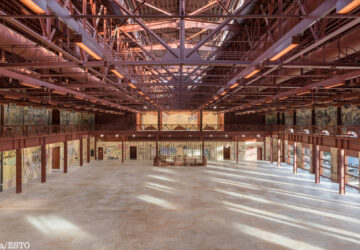


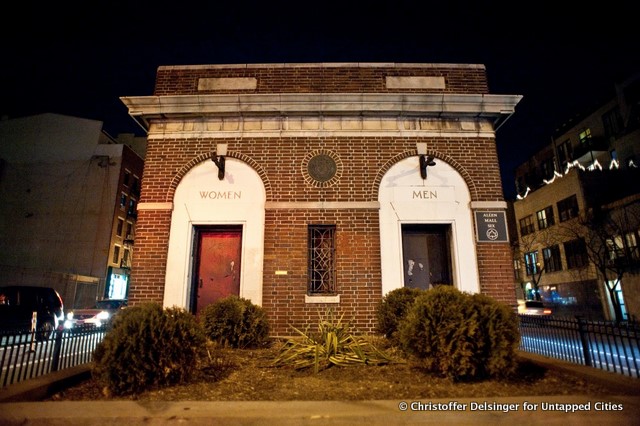
Recently Untapped New York discovered this at Bedford Avenue and N.7th in Williamsburg. Looks like something is in the works for 2010!
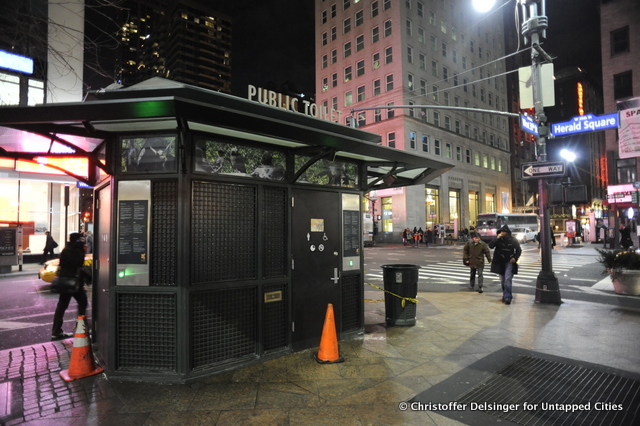
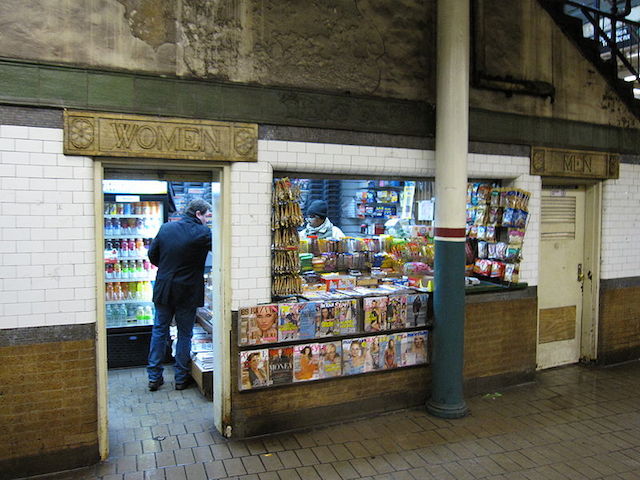
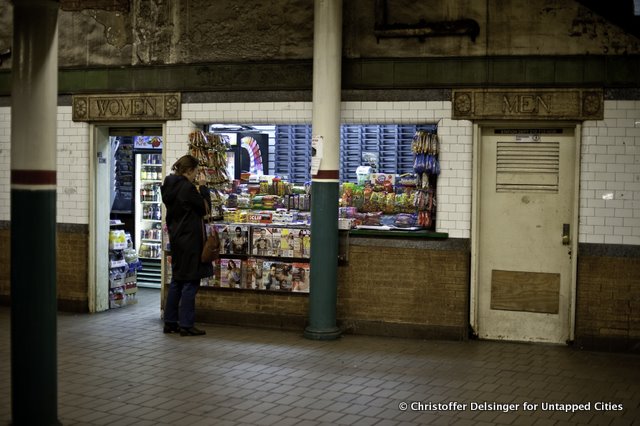
I first became intrigued with public bathrooms upon seeing the reppropriation of the Astor Place women’s room into a newsstand. Then I began to notice larger stand-alone beaux-arts buildings, and began to dig further. Today, the internet is littered with information about how to find bathrooms in New York City—nyrestroom.com, nyctoiletmap.com, restroomratings.com, and the global iPhone app SitorSquat by Charmin. But in real life, restrooms are harder to come by. In NYC as of April 2009, there were 666 park bathrooms, 78 subway bathrooms and the pay-per-use self-cleaning bathrooms in Herald Square. These figures have fallen sharply over the last half-century. In contrast, Singapore, which has a land area nearly 200 sq km less than New York City, has 29,500 public toilets.
Should the provision of bathrooms be considered a public good? In Italy, cafes and similar establishments are required by law to permit anybody to use the bathroom, regardless of being a customer. Cities such as Paris, Amsterdam and Gent, Belgium all have street-side options. New York City has swung the pendulum on this issue, and the history behind the present situation is typical of New York: long, complicated and wrought with political drama.
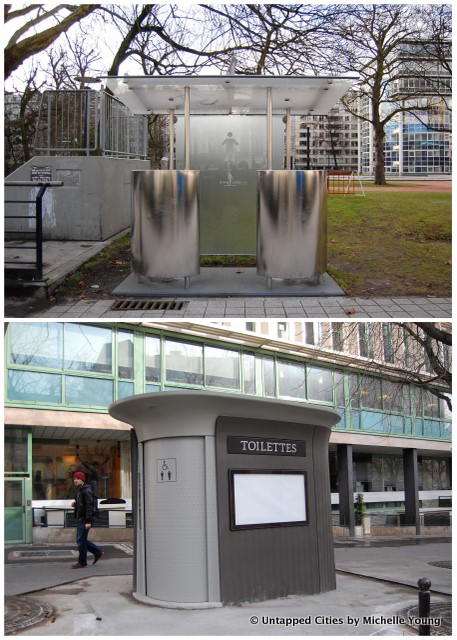
Top: Public Men’s Bathrooms in Gent, Belgium, Bottom: Public Toilets in Paris, France
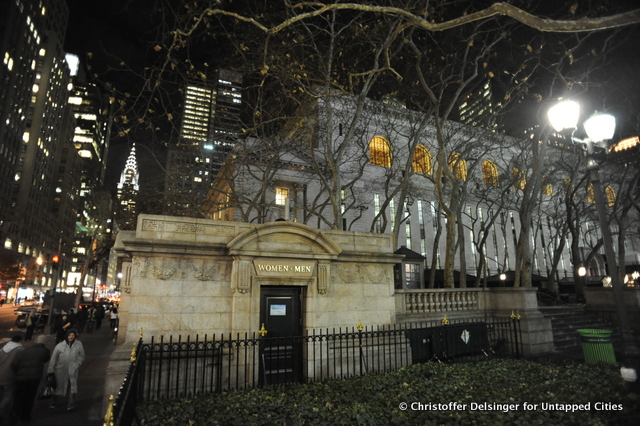
As early as 1898, citizen groups were lamenting New York’s lack of public toilets. Sigmund Freud told his biographer that to find a bathroom in New York City, “They escort you along miles of corridors and ultimately you are taken to the very basement where a marble palace awaits you, only just in time.” Henry Miller wrote, “I know that I am in distress when I walk the streets of New York. Wondering constantly where the next stop will be and if I can hold out that long.” Parks were the first to be retrofitted with toilets, with the subway system following. Robert Moses opened 145 toilets in New York City parks in 1934 alone. By 1940, the subway offered 1,676 public toilets. Some of these bathrooms are little architectural gems (Forgotten NY has compiled additional photos)
Bryant Park Bathrooms: Voted Best Bathrooms in the Nation by Citysearch
As the economy struggled in the 1970s, crime and vandalism increased in the subway system, and the majority of the bathrooms were closed to the public. In 1975, pay toilets were outlawed in response to the charge that they discriminated against women. Women always needed a stall, while men could relieve themselves anywhere, opponents argued. Other opposition included claims of discrimination against the disabled or that public restrooms would attract child molesters, vagrants and drug-dealers.
Mayors David Dinkins, Rudy Giuliani and Michael Bloomberg have all attempted to address the dearth of toilets, which the New York Times has termed “among life’s eternal mysteries.” Plans during Mayor Guiliani’s term were scrapped for fear of contract monopolies, and then later, although money was budgeted by the city council for toilets, the administration never acted upon it. Mayor Bloomberg finally signed a deal with Cemusa to install public pay-per-use toilets and new street “furniture”—you’ve probably noticed the new fancy bus shelters and newspaper stands.
Unfortunately, the pay-per-use self-cleaning toilets at Herald Square were not popular or cost-efficient, with focus groups reporting that users had a “profound mistrust of automation in the toilet sphere.” They have been replaced with manually cleaned toilets that nonetheless still look “space-age.” My hunch is that New Yorkers just like to be scrappy or in-the-know, like this Yelp user’s rating of best bathrooms in NYC ranging from Pottery Barn to the W Hotel. Or think about Seinfeld’s George Constanza who bragged “Anywhere in the city—I’ll tell you the best public toilet.”
Follow Untapped Cities on Twitter and Facebook. Get in touch with the author @untappedmich and the photographer at http://christofferdelsinger.wordpress.com/
Enhance Your Local Online Marketing With LocalVox


Fantastic posting!
Informative post, thanks for the blog. I enjoyed reading it.
Great post and photos as well. Thanks
I would like to know more information about the public bathroom at Allen Street and Delancey in New York City. Was it built during the 1800s? or is it more recent? Was it used by the immigrants who lived in nearby tenement buildings without bathrooms?
The first plan to build the public bathroom (known then as a comfort station) at Allen & Delancey was put forth in 1902 by W.W. Weeks, NYC Superintendent Public Baths and Comfort Stations. This bathroom (along with plans for bathrooms at 109th st and 2nd Ave & 41st St and 6th Ave, were in response to the poor conditions of the Rivington Street bath. The Rivington Street bath had 67 showers and 10 tubs, which was deemed inadequate to satisfy the supply. There is no direct mention of exactly who the clientele were but you can infer from the comment in the report: “From the plan and materials used it seems to be sufficient consideration was not given the fact that this comfort station would be used by a very different class of people from those using the same in private houses and institutions.” In addition, it was acknowledged in the same report that “If the best possible locations were given the free floating baths, even to the inconvenience of some lesser interest, they would be one of the most healthful and useful charities in the City.” The current building has been part of the NYC owned park property called “Allen Malls” since 1929, and legally acquired the property through condemnation in 1930. Hope that helps!
http://books.google.com/books?id=mQyqZEHcq7AC&printsec=frontcover#v=onepage&q=&f=false
http://www.nycgovparks.org/sub_your_park/historical_signs/hs_historical_sign.php?id=8249
This is just the sort of thing that I find fascinating. Thank you – I grew up in NYC and never knew about these places.
thanks for the feedback and kind words! if you have any favorite spots, please send them along, always looking for more material!
Hey, It’s nice to stumble upon a good site like this one. Do you care if I used some of your info, and I’ll put a link back to your blog?
Sure, no problem!
The New York State Plumbing code says that public toilets are to be provided by businesses that cater to the publci. See http://publicecodes.citation.com/st/ny/st/b900v07/st_ny_st_b900v07_4_sec003_par007.htm
How should one read this code? For example 403.1 category 2 seems to say that banks should provide restrooms for the public. Is that correct? Why is it then that no bank in NYC seems to provide a public restroom. Was some exemption passed at some point?
That part of the code seems to just refer to minimum fixtures, not necessarily for public use. There is separate section of the code for public bathrooms.
I’m always surprised there aren’t more options for us here in NY
Michelle,
Great post on public bathrooms in NYC! Maybe NY should explore Rio’s approach to public restrooms.
http://madeinbrazil.typepad.com/.a/6a00d8341c4f4c53ef0128779eb7e8970c-800wi
Best,
James
Thanks James! Are you back in New York?
Yep, I’m back in NYC teaching a summer youth program at Brooklyn College. So I will be here until it ends in the middle of August and then I’m off to Mexico for a few weeks. And you, which corner of the globe are you in at the moment?
Thank god and chain stores. Starbucks, Barnes & Nobles and Mickey D’s among other provide public pissoires for those of us who are bladderly challenged.
This is awesome.